The global battery industry is in a race to transition from conventional wet-electrode manufacturing to dry-electrode processes. Wet manufacturing requires mixing battery materials with organic solvents to form a slurry, which is then dried in massive ovens—a process that drains energy, inflates capital expenditures, and emits significant carbon.
While the dry-electrode process solves these issues, it has a glaring Achilles' heel: its reliance on polytetrafluoroethylene (PTFE) binders. PTFE is expensive, suffers from poor adhesion (often requiring an ironic wet-coated primer layer), and is a fluorinated polymer. With impending global restrictions on PFAS ("forever chemicals"), the industry urgently needs a fluorine-free alternative.
According to a recent breakthrough published in Nature Communications (DOI: 10.1038/s41467-025-66082-3), a research team from DGIST has found a revolutionary, yet shockingly simple, substitute: Parafilm® M. Yes, the same paraffin and polyethylene sealing film used in chemistry labs worldwide.
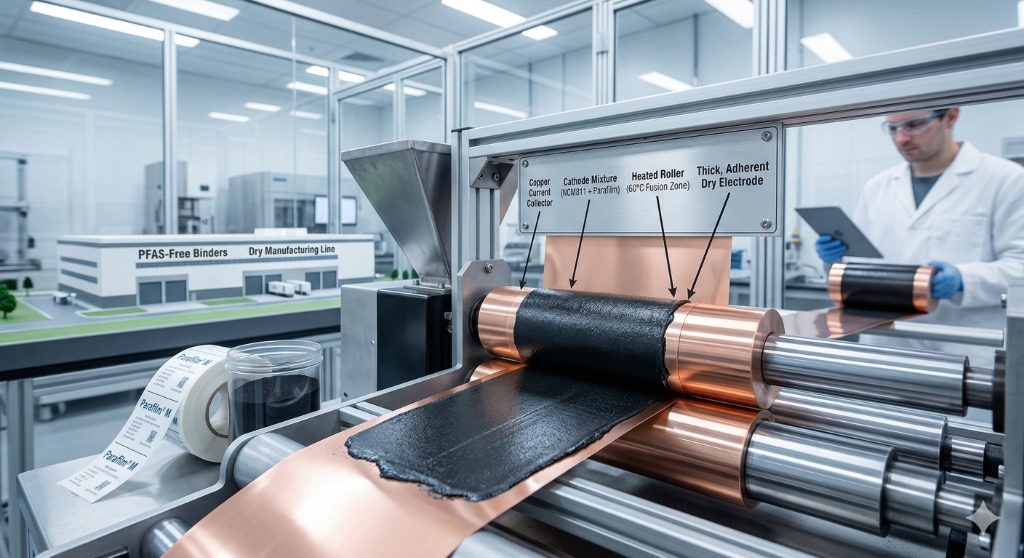
Here is a technical breakdown of how this candle constituent is reshaping electrode design, the hurdles it faces, and what it means for the gigafactories of tomorrow.
The Technical Pros: Why Paraffin Works
The research team successfully utilized Parafilm as a novel thermoplastic binder for thick, high-loading dry electrodes (supporting an NCM811 cathode over 5 mAh cm⁻² for up to 1,000 cycles).
- True Solvent-Free Adhesion: Because PTFE is notoriously non-sticky, manufacturers currently have to apply a wet adhesive primer to the current collector. Parafilm has a very low glass transition temperature (Tg). By applying mild pressure at a low temperature of just 60°C, the binder effectively fuses the active materials directly to the current collector without any wet-processing steps.
- Electrochemical Stability: One might assume wax is too delicate for a harsh battery environment. However, paraffin consists of saturated linear hydrocarbons. The strong C-H covalent bonds and the wide energy gap between its HOMO (Highest Occupied Molecular Orbital) and LUMO (Lowest Unoccupied Molecular Orbital) provide remarkable chemical stability. It resists oxidation and reduction even across a wide voltage window.
- Superior Ion Transfer: The researchers demonstrated that the binder distributes uniformly throughout the thick electrode structure, mitigating the carbon-binder domain (CBD) migration issues that plague wet-processed thick electrodes.
The Technical Cons: Where It Could Struggle
Despite the glowing electrochemical results, introducing a low-melting-point hydrocarbon into energy-dense cells presents distinct engineering challenges:
- Thermal Vulnerability (Low Tg): The paper notes that at elevated temperatures above its Tg, the Parafilm binder maintains a cohesive, "cheesy" nature rather than melting into a liquid. However, EV battery packs undergoing ultra-fast charging or operating in severe climates generate intense localized heat. Managing the mechanical integrity of a wax-based binder during prolonged high-temperature thermal events will require rigorous pack-level validation.
- Mechanical Softness vs. Expansion: While Parafilm works excellently for NCM cathodes, it is inherently softer than the rigid, fibrillizing nature of PTFE. If this binder is applied to next-generation anodes (like silicon) that experience massive volumetric expansion during lithiation, its mechanical elasticity may struggle to keep the electrode matrix intact over thousands of cycles.
- Extrusion Rheology at Gigascale: The team successfully verified the process using a twin-screw continuous extruder to make pouch cells. However, moving from pilot-scale extrusion to high-speed, roll-to-roll gigafactory production introduces complex shear forces. Ensuring the thermoplastic binder doesn't clump or shear unevenly at massive scales is a classic manufacturing hurdle.
What This Means for the Battery Industry
If commercialized by the targeted 2028 timeframe, this fluorine-free dry processing approach could drastically alter battery economics:
- Regulatory Future-Proofing: By eliminating PTFE, cell manufacturers can bypass impending PFAS bans in the EU and US, securing a compliant supply chain for the next decade.
- Massive Cost Reductions: Parafilm is ubiquitous and cheap. Replacing PTFE with a paraffin-based binder results in an estimated 95% reduction in binder costs. Furthermore, eliminating the wet-primer layer completely removes the need for solvent recovery systems and drying ovens, slashing both OPEX and CAPEX.
- Carbon Neutrality: According to the DGIST team, replacing PTFE with paraffin lowers the Global Warming Potential (GWP) of the binder material to just 1/2,200th of current levels.
The Verdict
The transition to dry battery electrodes is no longer just a Tesla-specific ambition; it is an industry-wide necessity. By bridging the gap between low-cost materials and high-efficiency manufacturing, paraffin-based binders offer a highly lucrative, PFAS-free path forward—provided cell engineers can confidently manage its thermal limitations.